Vivian Regan
The Big SleepVivian Regan, the elder daughter of General Guy Sternwood and the wife of the missing Rusty Regan, is both an intermediary in Philip Marlowe’s investigation and a protector of the family secrets that investigation uncovers. She moves between the Sternwood household, the criminal circles of Eddie Mars, and Marlowe’s office with composure and selective candor; her most consequential act is helping conceal Carmen Sternwood’s responsibility for Rusty’s death, a truth Marlowe ultimately discovers and agrees temporarily to withhold.
Identity and First Appearance
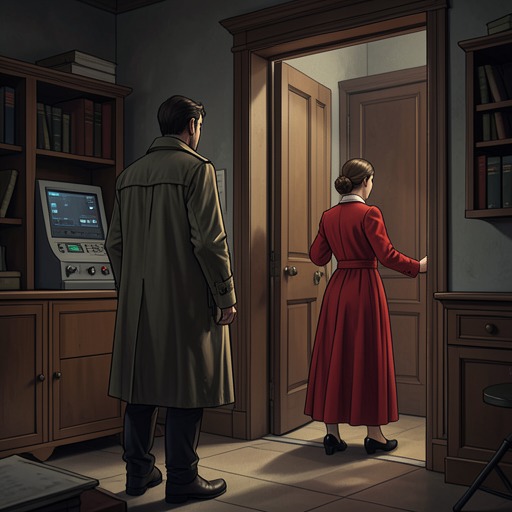
Vivian first appears to Marlowe in an oversized room whose white carpet, ivory furnishings, mirrors, and windows toward the foothills create an atmosphere of costly display. Relaxed on a chaise longue with a drink, she studies the detective coolly and remarks that she had thought private detectives existed chiefly in books or as disreputable figures in hotels. The exchange establishes her as someone alert to appearances and prepared to test the person entering her family’s affairs.
Marlowe’s first impression is openly shaped by his own gaze: he describes her build, clothes, and face before the conversation turns to business. Yet Vivian is not simply a figure being observed. She promptly names the stereotype she expects him to occupy, setting the terms of their encounter and making clear that she can watch and assess him in return. Her poise does not amount to uncomplicated openness; from the outset, she controls what she reveals.
The Investigation and the Photograph
The immediate crisis surrounding the family is Arthur Geiger’s blackmail scheme, which involves a compromising photograph of Carmen. Vivian brings Marlowe an envelope addressed to her at 3765 Alta Brea Crescent. Its messenger-service stamp records an 8:35 a.m. dispatch, and inside is a small photograph of Carmen seated in Geiger’s chair. The photograph makes the private threat concrete: what might have remained family rumor or coercive leverage is now an object that can be passed, hidden, or destroyed.
Vivian has reason to deal with the threat herself. She tells Marlowe that she will obtain the five thousand dollars demanded and says she has been a good customer of Eddie Mars. She adds a more personal connection: Mars’s blonde wife, she says, is the woman Rusty ran away with. That claim links the blackmail problem to the missing-husband inquiry and gives Marlowe a possible avenue toward Rusty, while also showing how readily Vivian presents a piece of family business as information to be weighed and used.
Her account of the photograph does not mean she has disclosed everything. The blackmail is connected to Geiger’s illicit book-lending operation, whose stock consists of rented volumes and whose customer information is kept in code. Marlowe later describes the coded list as containing about five hundred names and estimates that a substantial lending business could have generated as many as 125,000 rentals and at least $125,000 in receipts, assuming a one-dollar rental and a plausible share of repeat customers. Vivian is implicated in the business as a person familiar with its scale, but the available evidence does not establish her precise role in running it.
Marriage, Mars, and Public Appearances
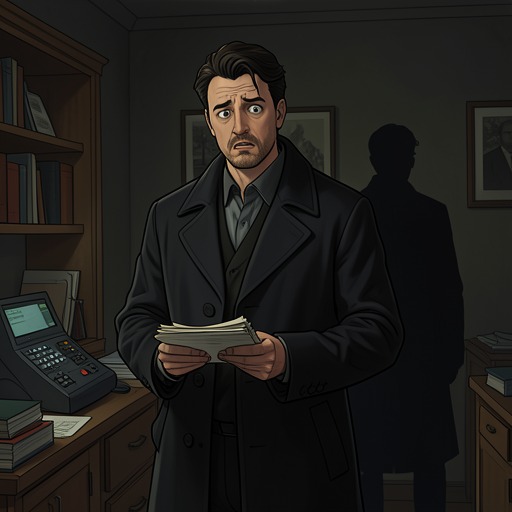
Rusty’s absence remains a point of friction between Vivian and Marlowe. When she asks whether Marlowe has found out where her husband is, he answers that he has not. Vivian rebukes him for letting information leak and insists that Rusty’s whereabouts concern her even if Marlowe claims not to be interested in the case. His reply—that other people keep bringing the matter to him—captures the investigation’s pressure on both of them: Rusty’s disappearance is not a private question that can be cleanly separated from the family’s public danger.
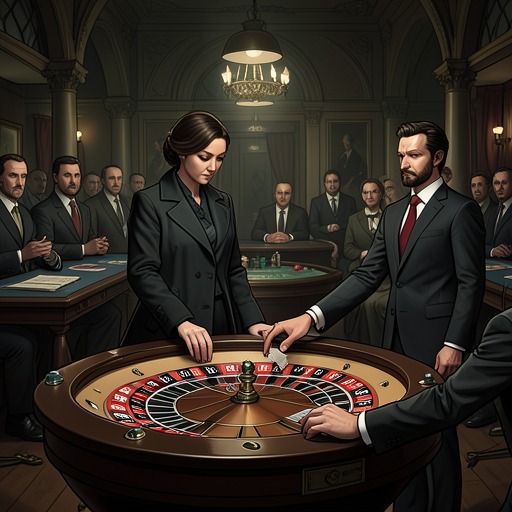
Vivian also appears at Eddie Mars’s gambling establishment. Mars identifies her to Marlowe as a visitor who is betting at the tables and doing fairly well. Later, when she is at the gaming tables, Mars addresses her as Mrs. Regan and offers to have someone accompany her home if she is finished playing. She does not answer him. The moment shows their familiarity in a public setting, but it does not by itself settle what lies behind their relationship or Vivian’s reasons for being there. Her earlier reference to Mars as a source of help over the blackmail, and her claim about his wife and Rusty, make his establishment part of the same web of rumor, money, and personal leverage.
Marlowe challenges the idea that Geiger’s blackmail was a scheme imposed on the family by Rusty. He tells Mars that Geiger was trying to blackmail General Guy Sternwood and that he suspects the General feared Rusty might be implicated. Mars disputes that interpretation: in his account, Geiger worked the same method on many people, using apparently legal promissory notes to test whether a target could be frightened into paying, and abandoning a demand when it failed. Vivian’s family is thus vulnerable not only to an individual threat but to a repeatable extortion method that turns private shame into a source of revenue.
Family Protection and the Hidden Truth
Vivian’s concern for her family is explicit. In a conversation with Marlowe, she says she worries about her little sister and, in a different way, about her father, because she wants to keep matters from him. The two forms of protection are not identical: Carmen needs safeguarding from the consequences of her actions, while General Guy Sternwood is being shielded from distress. Vivian’s loyalty therefore involves managing what each family member is allowed to know, not simply confronting the danger in public.
That protective role reaches its sharpest point in the truth about Rusty. At the end of the investigation, Marlowe understands that Rusty is dead and that Carmen killed him; Vivian has concealed her sister’s responsibility. The full disclosure to Vivian is not presented in the supplied evidence, but Marlowe’s conclusion makes her concealment central to the resolution. What had appeared to be an investigation into a husband’s disappearance and a possible flight with Mona Mars becomes a case of familial protection built around a death.
Vivian’s silence also helps explain why the investigation cannot be reduced to finding a missing man. She has allowed the uncertainty around Rusty to persist while seeking to contain threats against the living members of her family. The concealment protects Carmen from immediate exposure, but it leaves Marlowe to carry knowledge that unsettles his professional role and his relation to the Sternwoods.
Ending and Narrative Significance
After Marlowe confronts Vivian with what he has learned, he does not immediately take the truth to the authorities or to her father. Instead, he gives her three days to place Carmen somewhere she can be cared for, warning that otherwise he will reveal what happened. His decision grants Vivian a limited interval in which to act, but it is not an acquittal: the deadline makes clear that Marlowe’s protection of the family has conditions and that the hidden truth cannot simply be erased.
Vivian’s significance lies in the tension between disclosure and concealment. She supplies Marlowe with consequential information about the photograph, the money, and Eddie Mars, yet keeps the most devastating family fact from him until he has uncovered it. Her actions expose the difficulty of separating family loyalty from obstruction of the truth in a world where blackmail, compromised institutions, and private violence meet. Marlowe’s closing reflection on death as a long sleep places Rusty beyond the ordinary reach of justice, while Vivian remains among the living, responsible for what she has chosen to hide and for what she must do next.